

HyT Capital Portfolio | Sand AI Open-Sources the World's First Autoregressive Video Generation Model
Another heavyweight open-source player has emerged in the video generation field.
Today, Sand AI, the startup founded by Cao Yue — winner of the Marr Prize and the Tsinghua Special Award — has launched its video generation large model, MAGI-1. This is a world model that generates video by autoregressively predicting sequences of video patches. The generated results are natural and fluid, with multiple versions available for download.
Below are some official demos:
According to the official introduction, videos generated by MAGI-1 have the following features:
1. High fluidity, no stuttering, and the ability to continue indefinitely. It can generate continuous long video scenes in a single take, without awkward cuts or strange stitching — as smooth and natural as a movie.
2. Precise timeline control. MAGI-1 is the only model with second-level timeline control — allowing you to precisely sculpt every second, exactly as you envision.
3. More natural and lively motion. Many AI-generated videos suffer from sluggish motion, stiffness, or limited movement range. MAGI-1 overcomes these issues, producing more fluid and dynamic motion, with smoother scene transitions.
How good are the results? Machine Heart ran a few simple tests.
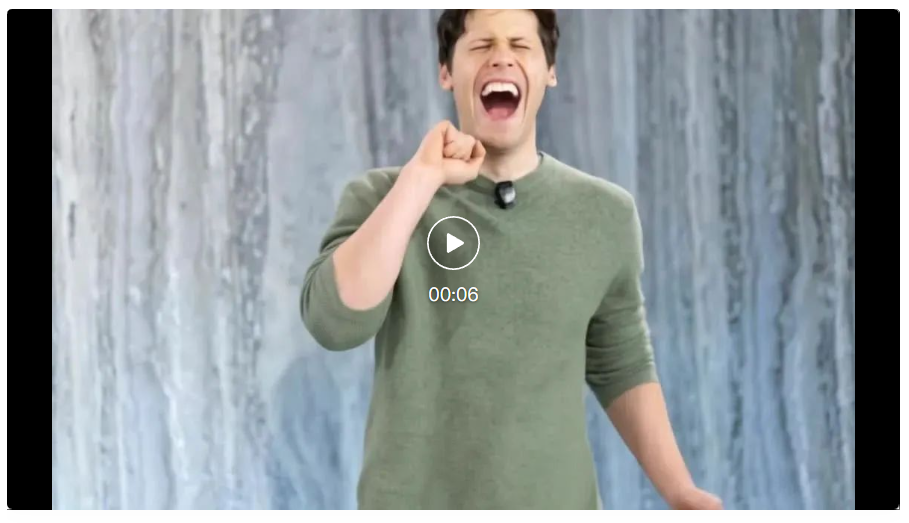
First, they started with an "OK" photo of Sam Altman and used the prompt: "the person in the image beats their chest and stomps their feet while laughing."
As can be seen, MAGI-1 first enhances the user's input prompt to generate a more detailed version.
After that, MAGI-1 uses this new prompt to generate the video. We waited about four minutes and got the result — the output was fairly decent.
Next, they tried a prompt where "Elon Musk walking the red carpet" shakes hands with the person on the left, then starts dancing. The result again came out well.
Sand AI also provides a video extension feature that can continue generating new video segments based on previously generated videos or user-uploaded videos — without requiring manual splicing. The system directly outputs an extended, longer video. Users can simply set the duration of each extension to one second, achieving precise control on a per-second basis.
During testing, we found that MAGI-1 currently supports video generation of 1 to 10 seconds in length, with each second of generation costing 10 credits per generation. Newly registered users receive 500 free credits.
Of course, once the free credits are used up, users can choose to continue using the service by paying. Sand AI offers two payment models: subscription-based and credit-based, with pricing as follows.
In addition, since Sand AI has open-sourced several versions of MAGI-1, they can also be downloaded and run locally.
Technical Report: https://static.magi.world/static/files/MAGI_1.pdf
GitHub Page: https://github.com/SandAI-org/Magi-1
HuggingFace Page: https://huggingface.co/sand-ai/MAGI-1
The release of MAGI-1 has caused quite a stir overseas. Open-source luminary Simo Ryu posted a question, wanting to know more about the team behind Sand AI. OpenAI researcher Lucas Beyer also shared some information he had gathered, indicating that he too is paying attention to Sand AI.
MAGI-1 Model Introduction
Based on the information disclosed by the team, we can understand the technical innovations behind this model.
MAGI-1 is a world model that generates videos by autoregressively predicting sequences of video patches, which are defined as fixed-length segments of consecutive frames. MAGI-1 is trained to denoise per-patch noise that increases monotonically over time, enabling causal temporal modeling and naturally supporting streaming generation.
It achieves strong performance on image-to-video (I2V) tasks conditioned on text instructions, providing high temporal consistency and scalability — made possible by several algorithmic innovations and a dedicated infrastructure stack. MAGI-1 further supports controllable generation via patch-wise prompting, enabling smooth scene transitions, long-horizon synthesis, and fine-grained text-driven control.
The Sand AI team stated that MAGI-1 offers a promising direction for unifying high-fidelity video generation, flexible instruction control, and real-time deployment.
On the project page, the team has provided pre-trained weights for MAGI-1, including the 24B and 4.5B models, as well as the corresponding distill and distill+quant models.
Model details are as follows (for more information, please refer to the technical report):
Transformer-based VAE
- Variational autoencoder (VAE) with transformer-based architecture, 8x spatial and 4x temporal compression.
- Fastest average decoding time and highly competitive reconstruction quality.
Autoregressive Denoising Algorithm
MAGI-1 generates videos chunk by chunk rather than as a whole. Each chunk (24 frames) is denoised holistically, and the generation of the next chunk begins as soon as the current one reaches a certain level of denoising. This pipeline design enables concurrent processing of up to four chunks for efficient video generation.
Diffusion Model Architecture
MAGI-1 is built upon the Diffusion Transformer (DiT), incorporating several key innovations to enhance training efficiency and stability at scale. These include Block-Causal Attention, Parallel Attention Block, QK-Norm and GQA, Sandwich Normalization in FFN, SwiGLU, and Softcap Modulation.
Distillation Algorithm
MAGI-1 adopts a shortcut distillation approach that trains a single velocity-based model to support variable inference budgets. By enforcing a self-consistency constraint — equating one large step with two smaller steps — the model learns to approximate flow-matching trajectories across multiple step sizes.
During training, step sizes are cyclically sampled from {64, 32, 16, 8}, and classifier-free guidance distillation is incorporated to preserve conditional alignment. This enables efficient inference with minimal loss in fidelity.
Evaluation
In-house Human Evaluation. Among open-source models, MAGI-1 achieves state-of-the-art performance (outperforming Wan-2.1 and significantly surpassing Hailuo and HunyuanVideo), particularly excelling in instruction following and motion quality, positioning it as a strong potential competitor to closed-source commercial models such as Kling.
Physical Evaluation. Thanks to the natural advantages of the autoregressive architecture, MAGI-1 achieves far superior precision in predicting physical behavior through video continuation — significantly outperforming all existing models.
Founded Just Over a Year Ago, Sand AI Unveils the World's First Autoregressive Video Generation Large Model
Sand AI was founded in January 2024 by Cao Yue, Zhang Zheng, and others.
Founder Cao Yue holds a Ph.D. in Software Engineering from Tsinghua University. During his doctoral studies, his research focused on machine learning and computer vision. After receiving his Ph.D. in 2019, he joined Microsoft Research Asia, where his representative works include Swin Transformer (winner of the ICCV Marr Prize), GCNet, VL-BERT, and DAN. Cao Yue is also a recipient of the Tsinghua Special Award. To date, his Google Scholar citations have approached 60,000.
Co-founder Zhang Zheng received both his bachelor's and master's degrees in Software Engineering from Huazhong University of Science and Technology, and is also one of the authors of Swin Transformer. He previously worked at Microsoft Research Asia as well, collaborating with Cao Yue for five years, and together they received the ICCV 2021 Best Paper Award (Marr Prize). According to Google Scholar statistics, Zhang Zheng's citations have approached 50,000.
To date, Sand AI has raised a total of nearly USD 60 million in financing. Three consecutive rounds were respectively led by Source Code Capital, Jinshi Capital, and Matrix Partners China, with follow-on investors including Hua Capital, Innovation Works, IDG Capital, Xianghe Capital, SenseTime Guoxiang, and well-known individual investors.
The MAGI-1 released by Sand AI is the world's first autoregressive video generation large model, representing a highly anticipated technical approach in image and video generation in 2025. Earlier this year, OpenAI also mentioned in its GPT-4o report that GPT-4o's image generation is an autoregressive model natively embedded in ChatGPT.
On the company's official website, we see that their next step is to achieve real-time, fast video generation, upgrading their AI model from a "creative tool" to a real-time experience.
We look forward to the company's next moves.
Back
Next article